
1、What is an eInvoice?
It is a structured form of an invoice data that is issued and exchanged electronically between a supplier and a buyer and reported electronically to the UAE Federal Tax Authority.
It is important to note that unstructured invoice formats such as pdf, word document, images, scanned copies and emails are not eInvoices.
Digitalization
Reduce human intervention in certain business and tax reporting processes with a view to making the UAE and its fiscal ecosystem more digitally enabled.
Efficiency
Optimize cost and core operations, reduce processing time and encourage a reduction in paper wastage with a view to helping meet sustainability objectives.
Digital economy
Encourage the development of a digital economy by establishing an eInvoice community that supports highly qualified digital experts.
Minimize VAT leakage
Over the last 6 years, revenue from VAT has significantly contributed to the Emirates revenue. It is important that we create an ecosystem where both unintentional as well as deliberate efforts of VAT leakage are identified and addressed. eInvoicing is one such mechanism that has helped countries minimize such leakages.
Economic Contribution
Contribute to the growth and competitiveness of the economy and utilize big data.
Security
Enhances security by reducing the risk of fraud and unauthorized access through encrypted transactions and secure data exchange protocols.
Contribute for policy making and government interventions
By adopting eInvoicing, UAE government will have access to the relevant data in near real-time which will help in providing deep insights to policy makers for identifying areas and sectors that need government support and assistance.
3、Benefits of eInvoicing for our business community
Making the latest technology accessible to all businesses
82% of the UAE businesses are micro businesses with less than AED 3m annual turnover. It is important for them to have a level playing field by having access to the latest technology at an affordable price that creates an environment for automation and simplification.
Significant reduction in invoice processing cost (about 66%)
Countries that have embarked on the journey of eInvoicing and successfully reaped its benefits provide confidence that when implemented correctly, eInvoicing can significantly reduce invoice processing costs for businesses and governments by up to 66%.
Improve cashflows by optimizing invoice cycle time
By standardizing and automating the Invoice creation and exchange, there are validations and controls built in the entire eInvoicing process that significantly reduce errors and deliver invoices to the buyers in near real-time. Thus, creating an opportunity for faster payment and better working capital management.
Financial visibility and richer information for decision making
With every aspect of the invoice being available in a machinable readable format, eInvoicing creates a plethora of opportunities for analysis and proactive decision making.
Exchange invoice beyond borders
By adopting a proven standard such as OpenPeppol, the business community has access to wider network where eInvoices can be seamlessly exchanged with businesses outside the UAE.
Simplifying compliance
Since eInvoicing mandates the reporting of invoice tax data to the FTA through UAE Accredited Service Providers, it will facilitate the automatic pre-population of certain fields in VAT returns and expedite refund processing.
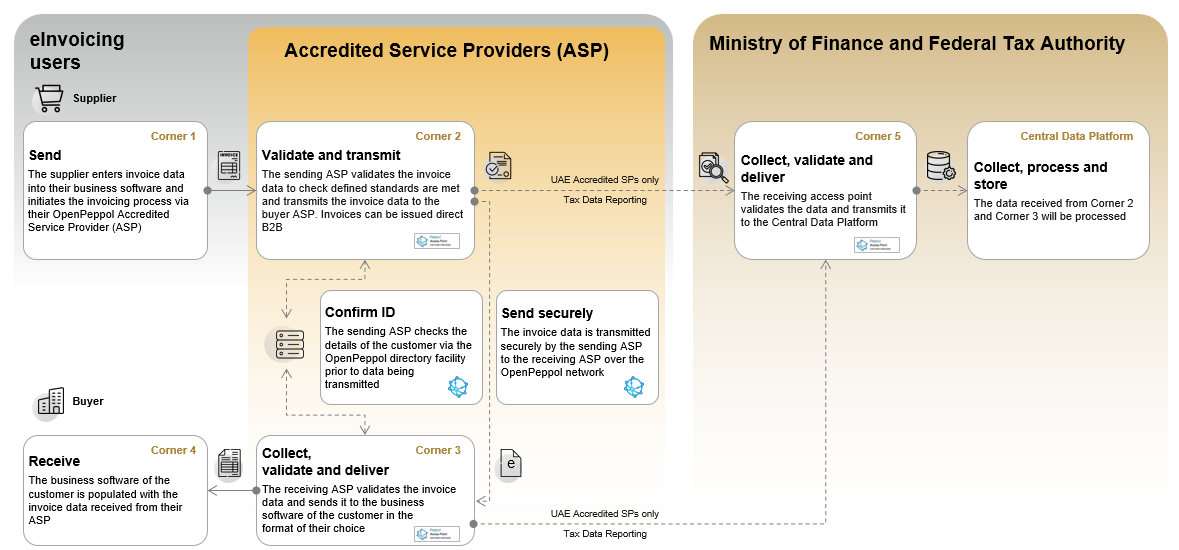
The following steps provide an overview of UAE’s eInvoicing model (Decentralized Continuous Transaction Control and Exchange - DCTCE)
(1)Supplier (Corner 1) submits eInvoice data (PINT AE) in an agreed format with its UAE Accredited Service Provider (Corner 2)
(2)C2 validates the eInvoice data received from C1 and converts it into the UAE standard eInvoice xml format (if C2 has received the eInvoice in a different format from C1).
(3)C2 transmits the eInvoice (in the xml format) to the Buyer’s UAE accredited Service Provider (Corner 3)
(4)In parallel, C2 reports the Tax Data Document (TDD) to Corner 5
(5)Upon validating the eInvoice, C3 sends a Message Level Status (MLS) to C2
(6)C3 submits the eInvoice to the Buyer (Corner 4) in an agreed format with its UAE Accredited Service Provider (Corner 3)
(7)Upon successful validation of the eInvoice, C3 also reports the Tax Data Document (TDD) to Corner 5. If the validation of the eInvoice was unsuccessful, C3 reports a negative MLS to C2 as well as to C5. In this scenario, there will be no reporting of the TDD to C5 by C3
(9)C5 sends a Message Level Status (MLS) to C3 once the TDD has been successfully reported
(10)C2 forwards the C3 exchange MLS and C5 reporting MLS to C1.
(11)C3 forwards the C5 reporting MLS to C4.
2024
UAE Service Provider accreditation
procedures
Accreditation of Service Providers
2025
EInvoicing related
Legislation updates
2026
Phase 1 go-live
of eInvoicing reporting